Mini Split Installation in Atlantic City, NJ
A new system here will heat from October through April and cool from June through September every year. Tell us about the house, and a licensed contractor who covers Atlantic County will get in touch.
Tell us about the job
It takes about a minute.
Eleven months of heating or cooling, and a cold-weather job
Atlantic County asks a mini-split to work most of the year, heat from October through April, cooling from June through September. Winter nights average 27°F here, cold enough that what matters is the unit's output at that temperature, not just its rating at a warmer test point. Summer afternoons average 84°F, steady work but not extreme, so the harder question for sizing is usually the cold side.
Any new mini-split has to clear the federal minimum for a split-system heat pump, 14.3 SEER2 for cooling and 7.5 HSPF2 for heating. That number is a floor, worth knowing so you can see where a unit you're considering stands against it. Power matters too. Statewide, 11% of households went at least 24 hours without power in 2024, and this area has logged 25 winter storms and 106 damaging wind events over the past ten years. A mini-split can run on a generator when the furnace can't, keeping at least one or two rooms heated.
- 7 months
- October through April, your system heats
- 4 months
- June through September, it cools
- 27°F
- the average winter night it heats against
- 84°F
- the average summer afternoon it cools against
NOAA nClimDiv, 1991–2020 normals
New Jersey requires HVAC contractors to hold a state license.
The license comes from the State Board of Examiners of Heating, Ventilating, Air Conditioning and Refrigeration Contractors. It covers the contractor, not each job, so it stays with the business rather than getting issued fresh for this installation. Towns and cities in New Jersey cannot add their own HVAC license on top of it, so this is the rule that applies here.
For a mini-split installation, that license is what stands behind the contractor's work. The other check comes from the local building office. Most cities and counties require a permit for a job like this and an inspection once the work is done, so someone besides the contractor looks at the installation before it is called finished.
Sources: New Jersey Legislature · New Jersey Division of Consumer Affairs
- Is a mini split worth it?
- For most homes here, yes. A mini split heats and cools without ductwork, and since Atlantic City needs heat seven months a year and cooling four more, one system that does both from a single outdoor unit earns its place. It also gives you control room by room, so you're not heating or cooling space nobody's using. A contractor can look at your house and tell you whether it makes sense to cover the whole place or just the rooms that need it most.
- How many rooms can a mini split cover?
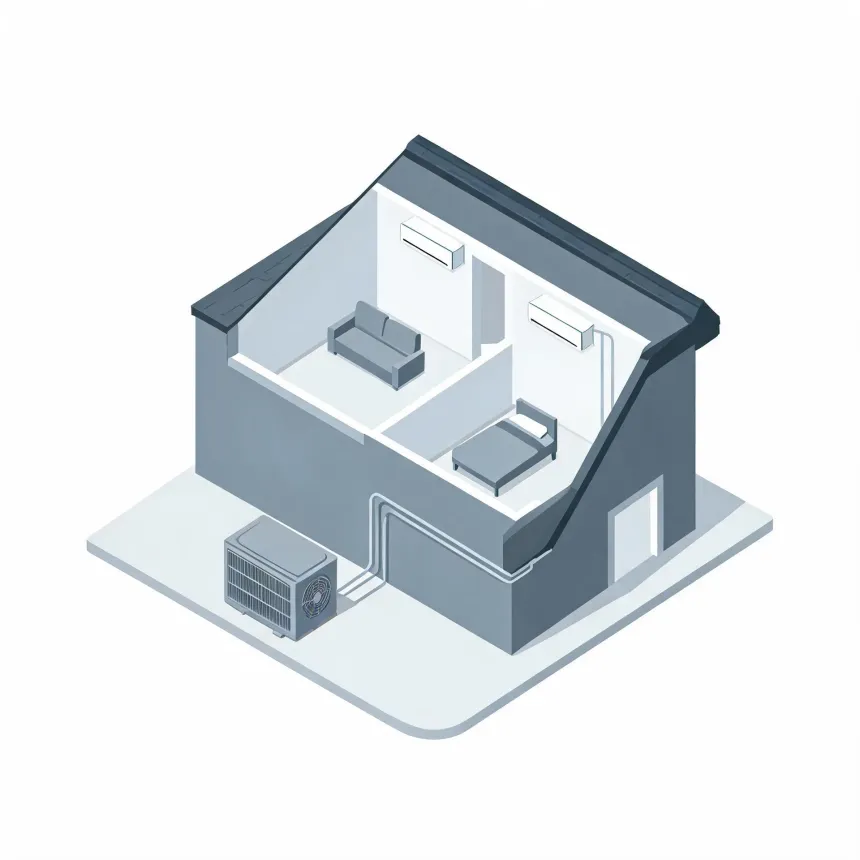
- That depends on the outdoor unit, since each one is rated for a certain number of indoor heads. Every indoor head is sized to the room it serves, so the outdoor unit has to be matched to the total load of all the rooms combined, not just the room count. A contractor will size the system room by room rather than guess at a number that fits every house.
- Can a mini split heat a whole house?
- It can, if enough indoor heads are placed to cover every room and the system is sized for winter nights that average 27 degrees here. Homes in Atlantic City need heat from October through April, so the system has to hold up on the coldest nights, not just the mild ones. A contractor can run the numbers on your house, including its layout and how much heat it loses, before deciding how many heads and what size outdoor unit the job needs.