Mini Split Installation in Trenton, NJ
A new system here will heat from October through April and cool from June through September every year. Tell us about the house, and a licensed contractor who covers Mercer County will get in touch.
Tell us about the job
It takes about a minute.
Trenton asks a mini-split to run 11 months a year
Winter nights here average 26°F from December through February, and homes need heat from October through April, seven months in all. Summer afternoons average 85°F, and cooling runs June through September, four more months. Together that is 11 months where a mini-split is doing real work, not sitting idle.
A unit installed new has to meet 14.3 SEER2 for cooling and 7.5 HSPF2 for heating, the federal minimum for split-system heat pumps since January 2023. Most homes here heat with gas, so a mini-split going in is often covering the cooling load and standing by for heat, and it needs to be sized for both jobs from the start.
- 7 months
- October through April, your system heats
- 4 months
- June through September, it cools
- 26°F
- the average winter night it heats against
- 85°F
- the average summer afternoon it cools against
NOAA nClimDiv, 1991–2020 normals
New Jersey requires HVAC contractors to hold a state license.
The license belongs to the contractor, not to the job. The State Board of Examiners of HVACR Contractors tests and records the contractor, and that same license covers a furnace swap, a water heater, or a mini-split installation. New Jersey does not let Mercer County or any town add its own license on top of that, so the license a contractor holds here is the one recognized everywhere in the state.
For this job, that license is what stands behind the person mounting and wiring the mini-split. In most cities and counties, an installation like this needs a permit from the local building office, with an inspection once the unit is in place and wired. That inspection is what catches a bad connection or a wiring mistake, separate from what the state license covers.
Sources: New Jersey Legislature · New Jersey Division of Consumer Affairs
- Is a mini split worth it?
- For most homes, yes, especially in a room that's hard to heat or cool with what you already have. A mini split runs on its own thermostat and only conditions the space it's installed in, so it can handle an addition, a converted garage, or a room over an attached garage without extending ductwork. Winter nights here average 26°F from December through February, and mini splits built after January 1, 2023 have to meet a 7.5 HSPF2 minimum for heating, so a properly sized unit will keep up. Whether it's worth it for your specific situation depends on the room and what you're trying to fix, which a contractor can walk through with you.
- How many rooms can a mini split cover?
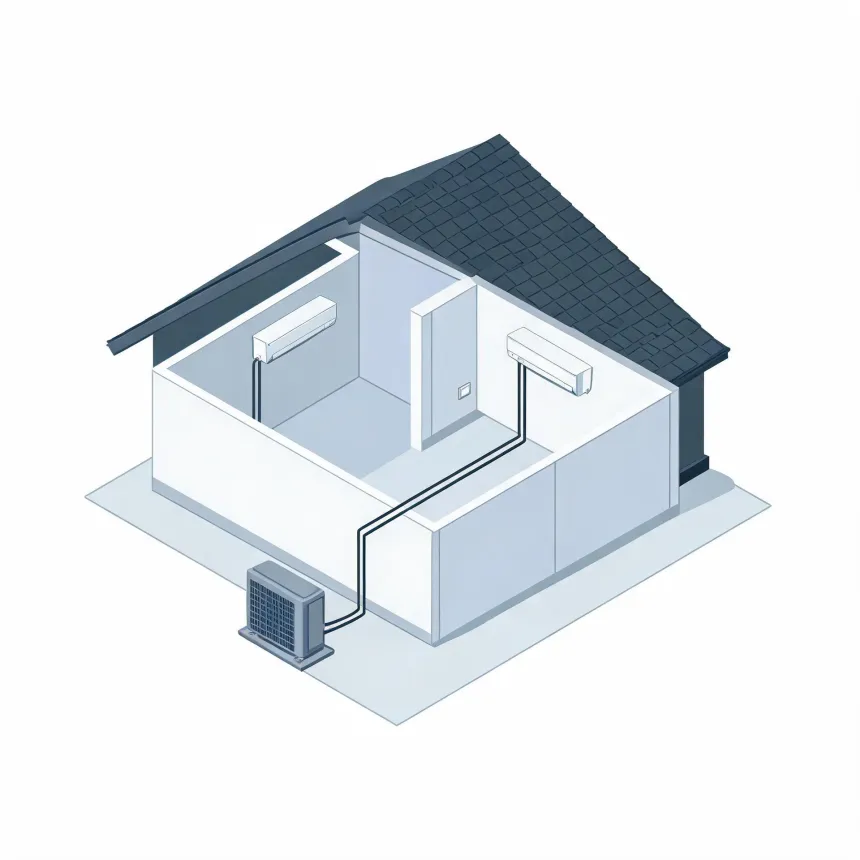
- A single indoor unit is built for one room or one open area. If you need to cover several rooms, you install a multi-zone system, which runs more than one indoor unit off a single outdoor condenser, each with its own zone and its own thermostat. The number of zones a multi-zone system can run depends on the outdoor unit's capacity and how the rooms are laid out, so that's a sizing question for a contractor to work out for your house.
- Can a mini split heat a whole house?
- It can, with enough indoor units placed to cover every room, but that only works if the house layout allows it. A multi-zone mini split heats each room it's connected to, so a whole-house setup means an indoor unit in every room or every open area, sized to the square footage and the winter low it needs to handle. Winter nights here average 26°F from December through February, so any system covering the whole house needs to be sized for that, not just for a mild day. A contractor can look at your floor plan and tell you whether a full mini-split setup makes sense or whether it works better paired with what you already have.