
How long an AC takes to cool a house in New Jersey
How long does it take for AC to cool down a house in New Jersey?
You just turned the AC down and you're waiting to feel it work. Maybe it's a sticky July afternoon and the house feels slow to catch up, or you're wondering if two or three degrees should take this long. You want to know what's normal before you decide something's wrong with the unit.
Most homes take two to three hours to cool down fully on a hot day
A central AC lowers a house about one degree every half hour under normal conditions. So if it's 85 inside and you want 72, expect somewhere around two to three hours. New Jersey summers run humid, and a humid house holds heat longer than a dry one, so the system has to pull moisture out of the air on top of lowering the temperature. That's normal work, not a sign of trouble. If your house is still climbing after three or four hours, or never gets within a few degrees of the setting, something is making the system work harder than it should, and that's worth a look before the next heat wave.

New Jersey summers carry a dew point around 63°F on average across June, July and August, according to NOAA climate data. That's the number that makes the air feel heavy even before the temperature climbs. Humid air holds onto heat, and your AC has to pull moisture out before the house actually feels cooler, not just lower on the thermostat. That's why it can read 74 and still feel sticky. A system that's clean and properly charged handles that extra load and keeps up. One that's low on refrigerant or has a dirty coil falls behind fast once the air outside gets heavy, and the gap between the number on the thermostat and how the house actually feels grows.
NASA POWER T2MDEW county cells weighted by homes




Slow to Cool or Stuck for Good
Slow to cool
- The air coming out of the vents feels cool, but the thermostat barely moves after twenty minutes.
- Filters clogged with a summer's worth of dust choke airflow, so the system runs longer without catching up.
- A unit low on refrigerant can blow cold air at the vent and still fail to pull heat out of the house.
- Outdoor units packed with leaves or grass clippings can't shed heat as fast, which slows the whole cycle down.
- If the ductwork leaks into the attic or crawlspace, some of that cooled air never makes it to the rooms you're in.
Never catches up
- The thermostat holds two or three degrees above the setpoint no matter how long the system runs.
- A thermostat set to a steep drop, like ten degrees at once, asks more of the system than a gradual pull-down.
- An undersized unit for the square footage will run constantly in New Jersey's humid summers and still lose ground on the hottest days.
- Ice forming on the indoor coil cuts off airflow entirely, and the house stops cooling until it melts.
- A failing capacitor can let the compressor start weak, so the system runs without doing its full share of the work.

The thermostat calls, and the outdoor compressor kicks on first.
Refrigerant inside the coil absorbs heat from air pulled across it.
The blower pushes that cooled air through the ducts into each room.
Warm air keeps returning through the vents and over the coil.
Why does one room take forever to cool off?
Walk the house while it's running. One room lags behind the rest, a vent barely pushes air, or the system seems to cycle on and off more than it used to. Maybe you notice a musty smell near the return, or the air feels cool but damp instead of dry. These are small signs on their own, but they add up to a system working harder than it should to do the same job. Left alone through a New Jersey summer, that extra strain tends to show up as a higher bill first, then as a repair call once a part gives out from running overtime.
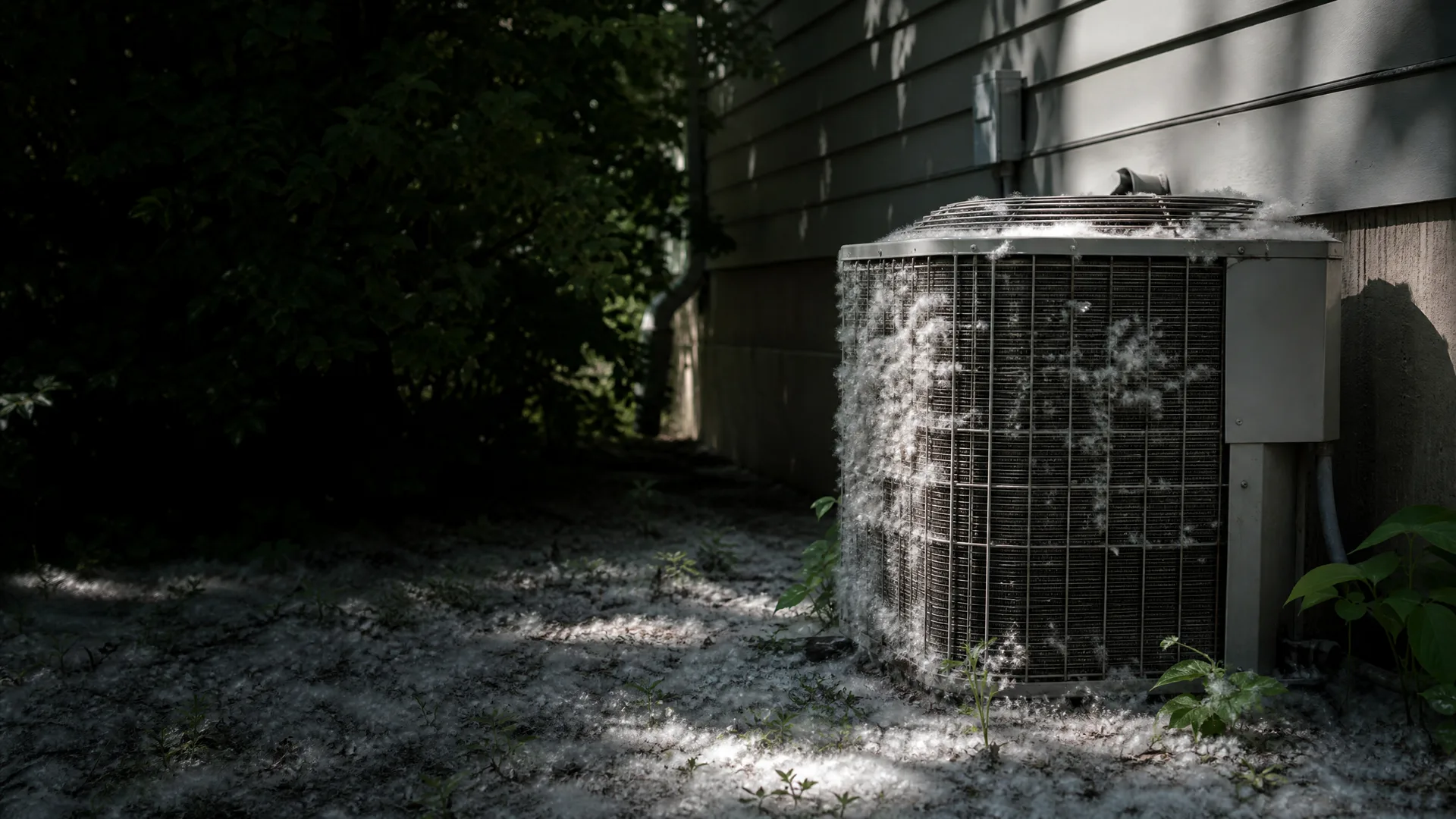
You're out pulling weeds along the side yard in late May, the kind of day that's warm but not sticky yet, and you walk past the condenser on your way to the hose. Something about it catches your eye. The fins are packed with white fluff, cottonwood seed caught in the grille like snow that never melted. You crouch down and see it's not just on the surface. It's worked into the fins themselves, the fuzzy drift of it from the tree two yards over. You make a note to hose it down before the real heat sets in, because you already know what a August afternoon asks of that unit, and you'd rather it breathe easy now than struggle for it in July.

What a slow cooldown does to your house and your bill
A system that struggles to catch up doesn't just run long. It runs long in August, on the days power costs the most, and New Jersey rates are already among the highest in the country. That difference shows up on the bill before it shows up as a breakdown. Meanwhile the parts working hardest to make up the gap, the compressor and the blower motor, are the ones that cost the most to replace.
You could spend an evening on this yourself: searching contractor listings, calling around to see who even picks up, explaining the same thing about the slow cooldown and the high bills to each one, then sitting with a stack of quotes trying to tell them apart. Or you could send one form and let that whole search become someone else's job instead of yours. The part that disappears isn't the repair. It's the hours you'd otherwise spend finding who does it.



It's off your list after this
A slow cooldown rarely fixes itself by the next heat wave. Dirty coils stay dirty, a low charge stays low, and a system already working hard through a New Jersey summer keeps paying for it on the power bill every month after. Figuring out which of those is actually happening means finding a contractor who'll look at the whole system, not just the thermostat. That's calls to a few companies, waiting on callbacks, explaining the same thing about the lagging room or the vent that barely blows, then doing it again to compare what each one quotes. You still have a summer to get through while that happens. Send this form instead and that search becomes someone else's job instead of yours. You go back to waiting for the house to cool down, except now there's a plan for why it's slow instead of just a thermostat you keep checking.
What a tune-up actually changes
A maintenance visit covers the parts that decide how fast cool air reaches you. The coil gets cleaned so it can pull heat out of the air without a layer of dust slowing it down. Refrigerant level gets checked against what the system calls for, since a unit even a little low won't move heat as well no matter how long it runs. The blower and its motor get looked over too, because a cooldown depends as much on moving air through the ducts as it does on cooling that air in the first place. None of this is guesswork. A tech checks numbers against the manufacturer's spec and corrects what's off.
Why this matters more in New Jersey
Every one of those checks carries more weight here than it would somewhere dry. A coil has to work harder pulling heat out of air that's already carrying a lot of moisture, so a dirty one falls further behind. A system low on charge still runs, but it runs longer to do the same job, and in New Jersey that extra runtime lands on some of the highest power rates in the country. A maintenance visit catches the small version of these problems, the slightly dirty coil or the slightly low charge, before a July heat wave turns it into a system that can't keep up at all.
Power costs 22.48 cents per kilowatt-hour statewide
At 22.48 cents per kilowatt-hour, every extra minute your AC spends struggling to catch up shows up on the bill fast. A system that cools slow because of a dirty coil or low charge isn't just uncomfortable, it's drawing power the whole time it's behind.
EIA-861 2025 statewide residential average

Waiting it out on your own
You could leave it alone and hope the next heat wave is easier. Maybe the filter gets swapped, maybe it doesn't. If the system is slow because of dust on the coil or a refrigerant level that's drifted off, none of that changes on its own. You're left checking the thermostat every twenty minutes on the next sticky afternoon, same as this one, and calling around for someone to look at it once you're tired of it.

Getting it looked at now
A maintenance visit finds the coil, the charge, the airflow, the things that actually decide how fast your house catches up. Once you send the form, you're done hunting for a contractor, done calling three places and repeating the same story about the lagging room and the twenty-minute wait. Someone licensed takes it from there. You're not fixing it yourself tonight, but you're not the one chasing it down either.
A healthy AC in New Jersey should bring a house down a few degrees within half an hour to an hour, depending on how far off the thermostat starts. If yours is taking longer than that, something is slowing it down, whether that's a dirty coil, a weak charge, or airflow fighting through a clogged filter. None of that gets better by itself, and every muggy afternoon it runs long adds to a bill already shaped by some of the highest power rates in the country. Instead of searching around for a contractor, calling a few, explaining the same slow cooldown over and over, and sitting with quotes to figure out who's worth hiring, you can send one form and let someone else sort out who's available and qualified. A maintenance visit gets at the parts behind a slow cooldown before the next heat wave makes it worse. You already know what your house feels like when the AC is working right. The point of checking it now is making sure it stays that way through the rest of summer.
Stop chasing an air conditioner pro
No charge to send it. You decide if you hire them.
Skip the part where you search for someone to look at it. One form, and you're done hunting through reviews and waiting on hold. Send it off and let the finding stop being your problem for a slow summer that's only going to get hotter before it's over.