
Profile view of a bearded man wearing a black baseball cap and a dark gray T-shirt against a plain light background.

Why your heat won't reach upstairs in New Jersey

RepairFurnace or heatingNew Jersey
Step 1 of 2

What ZIP code is the job in?

Heat that never reaches the second floor usually means your furnace and ductwork were sized for the house as it was built, not for how the air actually moves through it now. Warm air rises on its own, so the upstairs should run warmer, not colder. When it doesn't, the cause is almost always one of a few things: a duct run that's too narrow or too long to push air that far, a blower that's lost strength, a return vent upstairs that's blocked or missing, or a damper somewhere in the trunk line that's closed or stuck. In a lot of New Jersey homes, additions or finished attic space got tied into ductwork that was never meant to serve them, and the upstairs ends up last in line for whatever air the system puts out. None of this fixes itself, and running the furnace harder just raises the bill on gas or electric without solving why the air isn't getting there. Someone who can trace the duct run and test the airflow at each vent can tell you exactly where it's getting lost.

A man with grey hair and stubble in a dark sweater sits on a grey sofa indoors, looking off to the side, with a potted plant and a sunlit window behind him.
A man with gray hair, a beard and glasses, wearing a dark green sweater, sits on a gray sofa in a sunlit living room with a potted plant, table lamp and wooden sideboard behind him.
A middle-aged man with graying hair and a short beard sits on a blue sofa in a living room, looking toward a window, with a bookshelf, lamp and framed picture in the background.
A man with graying curly hair and a dark green sweater sits on a gray sofa in a sunlit living room, looking off to the side, with a framed picture, shelving, an armchair and a window with sheer curtains behind him.

Your furnace has one blower moving one set amount of air. That air splits off at the trunk line, and whatever the duct sizing sends upstairs is what you get, no more. In most two-story homes the return is on the first floor, so the lower level sits at a higher pressure and pulls warm air back down before it ever reaches the bedrooms above. Somewhere near the furnace or in the basement there's usually a damper controlling how much air goes to each floor, and if it's closed down or set wrong, one floor ends up shorted. Distance matters too. A run that travels far before it reaches a bedroom loses heat along the way, so that room runs cooler than one closer to the trunk. A dirty filter makes all of this worse, since it chokes the blower right at the source. And if the second floor was added after the house was built, its ducts are often spliced into a system that was never sized to carry that extra load in the first place.

Why the Upstairs Runs Cold

  • A furnace blower pushes a fixed amount of air, so if the trunk line or ductwork was never sized to add a second floor run, the upstairs gets whatever air is left over.
  • Return air pulls from the first floor in most two-story layouts, which drops the upstairs to a lower pressure and slows warm air from reaching it.
  • A damper inside the duct near the furnace or in the basement can be set wrong or stuck closed, sending most of the heat to one floor only.
  • Long duct runs lose heat along the way, so a bedroom at the far end of the upstairs run can end up several degrees cooler than one near the trunk line.
  • A clogged filter restricts airflow at the blower itself, and the rooms farthest from the furnace are usually the first to lose heat when that happens.
  • If the second floor was finished after the house was built, its ducts were often tied into the existing system rather than sized to carry its own load.
A gray high-efficiency furnace stands on a concrete basement floor beside galvanized sheet-metal ductwork, white PVC vent pipes, copper and black piping, and unfinished wood stud framing.
The blower runs steady and the ducts overhead carry warm air up without a fight.
A gray furnace with two access panels stands on a concrete basement floor beside sheet-metal ductwork, with pipes, flexible conduit and an electrical box on the concrete wall to the left.
Panels stay shut and the furnace idles quiet while the upstairs still sits cold.
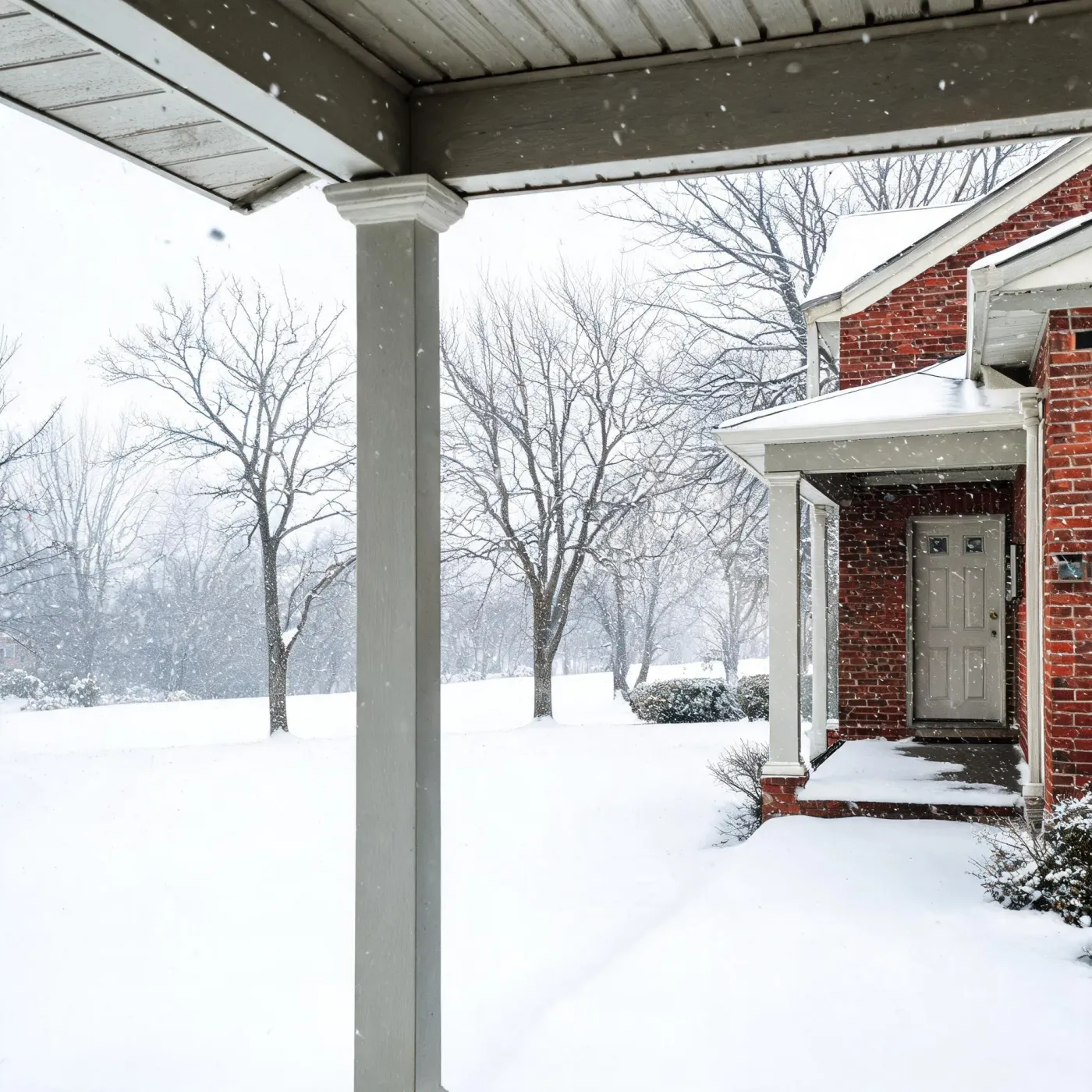
View from under a covered porch with a white column toward a red brick house entrance with a gray door, surrounded by deep snow, bare trees, and falling snowflakes.

Winter nights average 26°F across New Jersey, according to NOAA climate data. At that temperature a furnace that's already struggling to push air upstairs has to run longer to make up the difference, and a long run on a cold night is when a weak duct run or a tired blower shows itself most. You might notice the first floor warms up fine while the thermostat upstairs barely moves, or the furnace kicks on again just a few minutes after it shuts off. That pattern tends to show up on the coldest nights first, before it starts happening on milder ones too.

NOAA nClimDiv 1991-2020 county normals weighted by homes

Why does your bedroom still feel cold with the furnace running

You can hear the furnace cycling on and off downstairs, feel warm air at the first floor registers, and still need a sweater in the upstairs hallway. Bedroom doors closed overnight make it worse, since the return air has nowhere to pull from up there. Some rooms over the garage or at the end of a long duct run stay noticeably colder than the rest of the house no matter how long the furnace runs. On the coldest nights the thermostat downstairs is satisfied long before the upstairs catches up, so the furnace shuts off and the chill sets back in before the next cycle. Left alone, the furnace ends up running longer and more often trying to close a gap it was never set up to close, and that shows up on your gas and electric bill.

A gray high-efficiency furnace with white PVC vent pipes stands beside sheet-metal ductwork and a water heater in an unfinished basement with concrete walls and wood framing.

Furnace keeping up

The blower is matched to the duct run, so air moves through the trunk line and up into the second floor without losing pressure along the way. The flue draws clean and the burners cycle on a normal schedule. Every room gets its share of the air the furnace is making.


A beige gas furnace with a metal flue pipe stands in a basement against concrete block walls, beside sheet-metal ductwork, copper and white plastic pipes, and a water heater at right.

Furnace falling behind

Galvanized ducts built for a smaller house choke off the upstairs run, so the blower works harder for less air at the top of the stairs. A furnace in this shape runs longer to hold the same temperature, and on a cold night that extra strain is where a duct problem turns into a furnace problem. A local tech who services this equipment every winter can tell you which one you're looking at.

An older beige furnace with two louvered vent panels stands on a concrete basement floor, connected to galvanized ductwork and a metal flue pipe, with gas piping and flexible conduit on the wall behind.
Before you get your furnace repair
A beige high-efficiency furnace in an unfinished basement, with white PVC vent pipes, a yellow gas line, metal ductwork, and exposed wood framing on a concrete floor.
After you get your furnace repair

A local pro for your furnace repair

A furnace that can't get heat upstairs is a duct and airflow problem, and tracing it in a two-story house takes someone who has opened up that kind of trunk line before, in houses like yours around New Jersey. A local contractor who does this work all winter knows where that second floor run usually chokes, whether it's a damper stuck shut, a blower that's undersized for the add-on, or a return pulling too much air back downstairs before it ever climbs. Send this request and it goes to one licensed contractor near you, not a handful competing for your callback, so the person who shows up already has a sense of what to check first. That matters on a night when it's in the 20s outside and your bedroom still hasn't warmed up by the time you want to sleep. Getting the right person looking at your ductwork is the step that actually changes what happens upstairs this winter.

A gray residential furnace with two panel doors stands against a plain light wall in a concrete-floored room, connected to metal ductwork and white and copper pipes.

Why the blower can't push harder

A furnace blower runs at a fixed speed set when the system was installed. It moves a set volume of air through the ducts it was matched to, not more. Asking it to cover a second floor it wasn't sized for doesn't make it work harder, it just means less air reaches the far end of the run. The motor isn't struggling. The ductwork is handing it more distance than it was built to cover.

A gray high-efficiency furnace with white PVC venting pipes stands against a plain wall in a basement, connected to sheet-metal ductwork on a concrete floor.

What a long duct run does to air

Air loses pressure as it travels, and every foot of duct, every turn, every joint takes a little more off. A trunk line that was fine reaching a one-story layout starts short-changing the upstairs once it has to climb and branch further. By the time air reaches a second-floor register at the end of a long run, it's moving slower and cooler than what comes out of a register near the furnace.

A man seen from behind raises his hand to wave at a woman standing in the open front doorway of a single-story house with gray shingle siding, white columns and a gabled porch entry.

What this does to your house and your bill

A cold upstairs changes how you live in your own house. You keep the thermostat higher to force enough heat up the stairs, and the first floor runs warm while the bedrooms still don't catch up. The furnace answers by running longer on every cycle, and with New Jersey power rates among the highest in the country, that extra runtime shows up on the bill whether the gas or the electric side is doing the work. Shut bedroom doors to hold in heat and you've also cut off the return path the system needs, so the imbalance feeds itself.

Left alone, an undersized duct run doesn't fix itself with a new thermostat or a bigger furnace. It takes someone who has traced this kind of trunk line before, in a two-story house like yours, to find where the air is actually losing pressure. A local contractor who works on furnaces all winter in New Jersey homes will know where that search usually starts, and you'd be matched with one contractor, not a handful of companies calling about the same job.

A living room corner with a beige upholstered armchair holding navy and striped cushions, a small round wooden side table with a carved bowl and a potted green plant, a framed landscape picture on a pale wall, built-in shelving, and a curtained window.
  1. Furnace fires and the blower pushes air into the trunk line

  2. Air splits off into branch ducts feeding each floor

  3. Undersized branch runs lose pressure before reaching the second floor

  4. Return air pulls mostly from the first floor, starving the upstairs loop

A woman with shoulder-length brown hair wearing a beige knit cardigan sits in a gray upholstered armchair near a window, looking off to the side with a slight smile, with bookshelves blurred in the background.
A woman and a sleeping child wrapped together in a cream knitted blanket on a couch, with a potted plant, framed photo and lit lamp in the background.

A duct run can be fixed. Adding a boot, resizing a branch, or balancing the dampers gets more air upstairs without touching the furnace itself.

A furnace that's too small for the house can't be balanced into working. If the upstairs still won't catch up after the ductwork's been checked, the furnace itself is the problem.

Winter nights average 26°F statewide

At 26°F, your furnace has to push heat the full distance to the second floor on most winter nights, not just on the occasional cold snap. If the duct run upstairs is already short on air, those are the nights the gap between floors shows up most.

NOAA nClimDiv 1991-2020 county normals weighted by homes

Where this leaves your upstairs

  • A cold upstairs with a warm first floor almost always points to the duct run and the return air setup, not the furnace itself.
  • Resizing a branch, adding a boot, or balancing dampers can get more air to the second floor without replacing the furnace.
  • A furnace that's genuinely too small for the house is a different problem, and balancing the ducts won't fix that one.
  • Tracing an undersized trunk line through a two-story house takes someone who has done it in homes like yours around New Jersey before.
  • You're matched with one licensed local contractor who works on furnaces all winter and knows what usually fails in this setup, so you're not fielding calls from several companies.
  • Once the duct run is corrected, the upstairs should hold its own through a 26°F night instead of falling behind the first floor.

Cold bedrooms with a warm first floor is a duct problem. The air your furnace makes isn't getting upstairs in the amount it needs to, usually because the branch run or the return air setup was never built for how the house is used now. That's fixable work. A boot added, a branch resized, dampers balanced so the first floor stops taking more than its share. None of that means a new furnace.

There's one exception. If the furnace itself is undersized for the house, no amount of duct work gets the upstairs to catch up, and that's a separate conversation from the one above. A contractor who's traced this kind of trunk line before, in two-story houses around New Jersey, can tell you within the visit which problem you actually have.

That's the part worth getting right before anyone touches a duct or a damper. You're matched with one licensed local contractor, not a handful of companies competing for the job. Someone who works on furnaces all winter in houses like yours knows which branch runs tend to lose pressure first and where the return air usually falls short on a two-story layout. That's the kind of thing you learn from doing it every season, not from a single visit.

Get the duct run corrected and the upstairs should hold its own on a 26°F night instead of lagging behind the first floor the way it has been. The furnace was never the problem. Where the air went after it left the furnace was.

Elevated view over a dark standing-seam metal roof with a stone chimney and wood-sided gable, surrounded by conifers and autumn-colored trees with forested hills under an overcast sky.

Get the right pro for your furnace

Get a local pro

You only hire the pro if you want to.

A contractor who traces duct runs in two-story homes all winter can usually spot a starved branch line faster than a guess-and-check approach ever will, which matters most on the nights your furnace is already working hardest to reach the second floor.