Mini Split Installation in Hackensack, NJ
A new system here will heat from October through May and cool from June through August every year. Tell us about the house, and a licensed contractor who covers Bergen County will get in touch.
Tell us about the job
It takes about a minute.
Eleven months of the year, your mini-split is working
Hackensack asks a lot of a heat pump. Winter nights average 25°F from December through February, and homes here need heat from October through May, eight months of the year. Add the three months of summer cooling, June through August, with afternoons averaging 84°F, and the system is working eleven months a year.
A unit installed here has to hold up on both ends, cold enough to still deliver heat in the depths of winter and strong enough to keep pulling humidity out of the air all summer. Any mini-split installed new has to meet the federal minimum of 14.3 SEER2 for cooling and 7.5 HSPF2 for heating. In a climate that leans on the system this much, that minimum is the floor, not the target.
- 8 months
- October through May, your system heats
- 3 months
- June through August, it cools
- 25°F
- the average winter night it heats against
- 84°F
- the average summer afternoon it cools against
NOAA nClimDiv, 1991–2020 normals
New Jersey requires HVAC contractors to hold a state license.
The license comes from the State Board of Examiners of HVACR Contractors, not from Bergen County or any town in it. New Jersey does not let cities and towns layer their own HVAC license on top of the state's. What the license covers is the contractor, tested and on file with the state. It is not a sign-off on this particular installation.
That sign-off on the job itself usually comes from the local building office. In most cities and counties, installing a mini-split needs a permit, and an inspection once the work is done, and that inspection is what checks that this specific installation was done right.
Sources: New Jersey Legislature · New Jersey Division of Consumer Affairs
- Is a mini split worth it?
- For most homes it comes down to what you're heating or cooling and whether ducts already reach there. A mini split puts heat where a furnace or window unit can't easily reach, like an addition, a garage, or a room over a garage that always runs cold. Winters here drop to 25°F on average, so the outdoor unit and the model you pick both matter for keeping up on the coldest nights. A contractor can look at the space and tell you whether it covers your needs or works better alongside what you already have.
- How many rooms can a mini split cover?
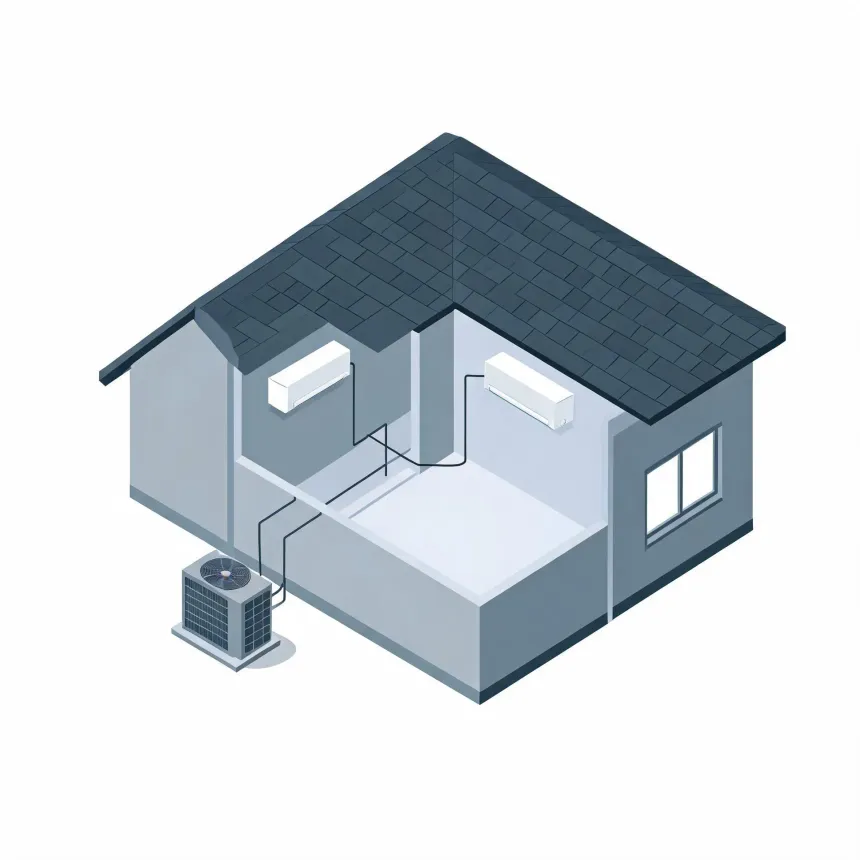
- A single outdoor unit can run one indoor head or several, depending on the system. Single-zone systems cover one room or one open area well. Multi-zone systems connect several indoor heads to one outdoor unit, each with its own thermostat, so you can heat or cool different rooms at different times. How many rooms makes sense for your house depends on the layout and where the heads can go, which is worth having a contractor walk through in person.
- Can a mini split heat a whole house?
- It can, but it takes the right number of zones placed where the heat needs to go. A multi-zone system with a head in each main room can heat a whole house the same way a furnace does, and modern heat pumps keep working even at 25°F, which is the average winter low here. Homes here need heat from October through May, so the system has to be sized for that stretch, not just for a mild day. A contractor can size it room by room and tell you whether whole-house coverage makes sense for your layout.