



Mold in air ducts in Newark, NJ

A galvanized steel round duct with a 90-degree elbow and a white louvered vent cover on one end, shown against a plain gray background.
Find a pro near me

Mold in air ducts usually means moisture got in somewhere, and Newark's muggy summers make that easy to happen. If the AC is oversized or the system runs short cycles, it cools the air without pulling enough humidity out of it, and that damp air sits in the ductwork where mold can take hold. A musty smell when the air turns on, dust that looks dark or speckled near the vents, or allergy-type symptoms that ease up when you leave the house are the usual signs. Dirty ducts and mold are not the same thing. Mold needs moisture, so a leak in the ductwork, a clogged condensate drain, or ducts running through a damp basement or crawl space is often part of the cause. Cleaning the ducts clears out what has already grown, but whatever let moisture in will cause it again unless that gets fixed too.

Empty basement room with bare concrete walls and floor, and an exposed wood-joist ceiling carrying sheet-metal ductwork, insulated pipes, and recessed lights.
Clean metal, dry joists, no staining or musty smell when you stand under the vents.
Basement ceiling with galvanized sheet metal ductwork, round pipes and rectangular plenums running between wooden joists above a bare concrete foundation wall and floor.
Dark spots on the duct seams or a musty smell near the vents mean mold has already taken hold.

Mold needs two things to grow in a duct system: moisture and something to eat. The dust that settles on duct walls is food enough, so once water gets in, growth can start fast. Flex duct makes this worse where it sags, because standing condensation sits there instead of draining or drying. If the insulation or liner around the ducts gets wet, mold can take hold inside that material, out of reach of any surface cleaning. The coil and the plenum right after it tend to be the first places affected, since that's where air is coldest and wettest as it leaves the system. Once mold is established anywhere in the system, a musty smell when the blower kicks on is spores moving through the ducts and into the rooms, not mold staying put in one section. A clogged filter adds to the problem. It slows airflow enough that moisture lingers in the ducts rather than passing through and drying as it should, giving any mold already there more time to spread.

How Mold Gets a Foothold

  • Mold needs a food source, and the dust and skin cells that collect on duct walls give it plenty to feed on.
  • A musty smell when the system kicks on means spores are circulating through the house, not just sitting in one spot.
  • Flexible ductwork with sagging sections holds condensation longer than rigid sheet metal, giving mold more time to take hold.
  • A duct liner or insulation that stays wet can grow mold inside the material itself, where a wipe-down never reaches it.
  • Mold spreads fastest near the evaporator coil and the supply plenum, since that's where the coldest, wettest air collects.
  • A dirty filter restricts airflow and lets moisture linger in the ducts instead of moving through and drying out.
An older man with gray hair and a beard, wearing a dark snow-dusted jacket and scarf, stands smiling in a warmly lit interior hallway with a lit table lamp, a vase of dried branches, and a framed picture in the background.
An older man in a dark snow-flecked overcoat and scarf stands smiling in a warmly lit home entryway, with a glass-paned door showing darkness outside and a lamp-lit room visible through a doorway behind him.
An older man with grey hair and a beard, wearing a dark coat dusted with snow, stands in a dimly lit entryway with a ceiling lamp, a side table with two shaded lamps, and a lit fireplace visible in a room beyond.
An older man with gray hair and a beard, wearing a dark coat dusted with snow, stands smiling in a doorway of a warmly lit home with a sofa, lamp and window visible behind him.

Why does mold keep coming back in your ducts?

  • Half the homes here were built by 1958

    Half the homes in Essex County were built in 1958 or earlier, and older duct runs often have seams and joints where damp air settles and mold gets a foothold.

  • Heat runs October through May

    Heat runs October through May here, about eight months. That's eight months of a closed-up system where any trapped moisture has no chance to air out.

  • Cooling runs June through August

    Cooling runs June through August, and that's when humidity gets pulled into the ducts fastest. Mold that took hold over winter finds the most food then.

ACS 2020-2024 · NOAA nClimDiv 1991-2020

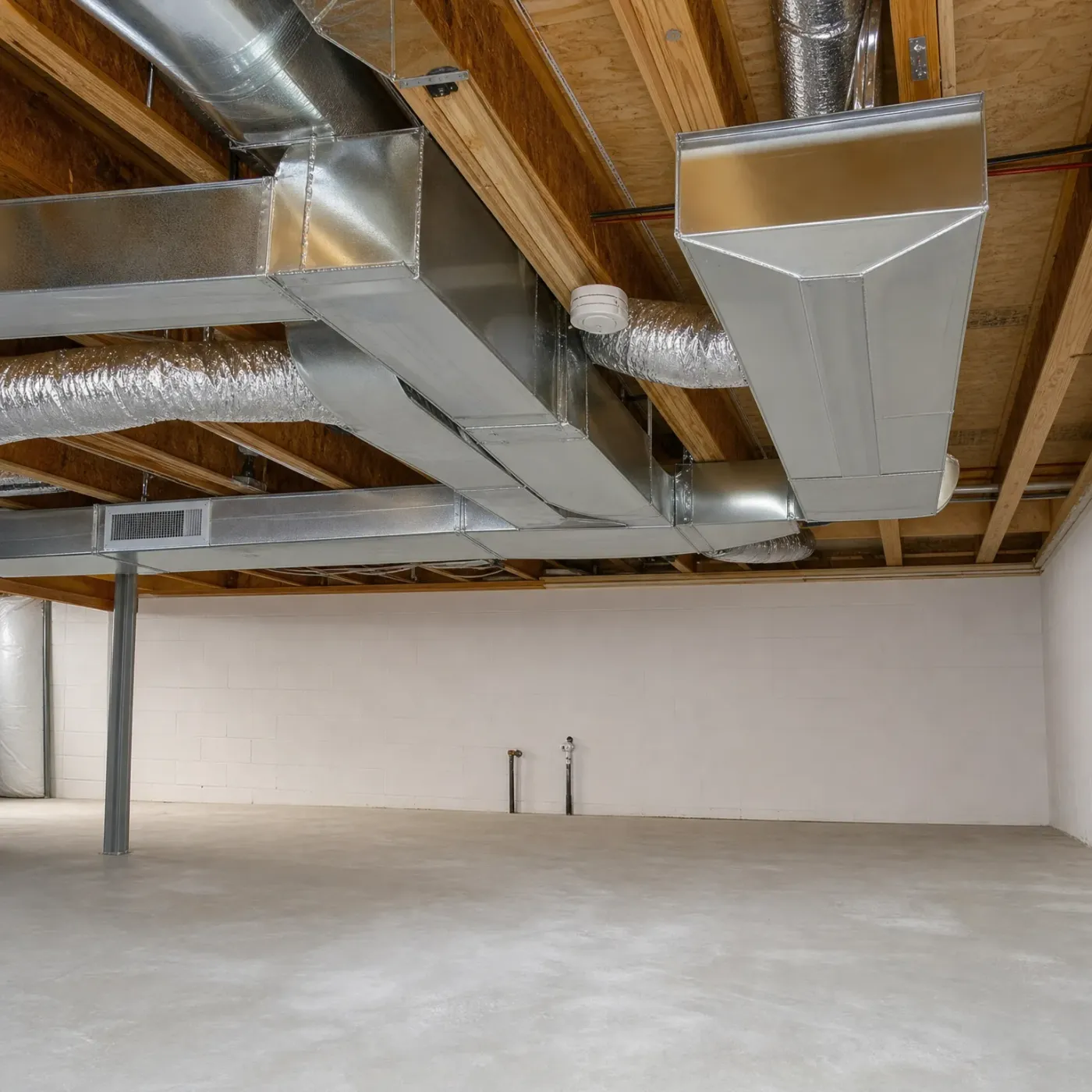
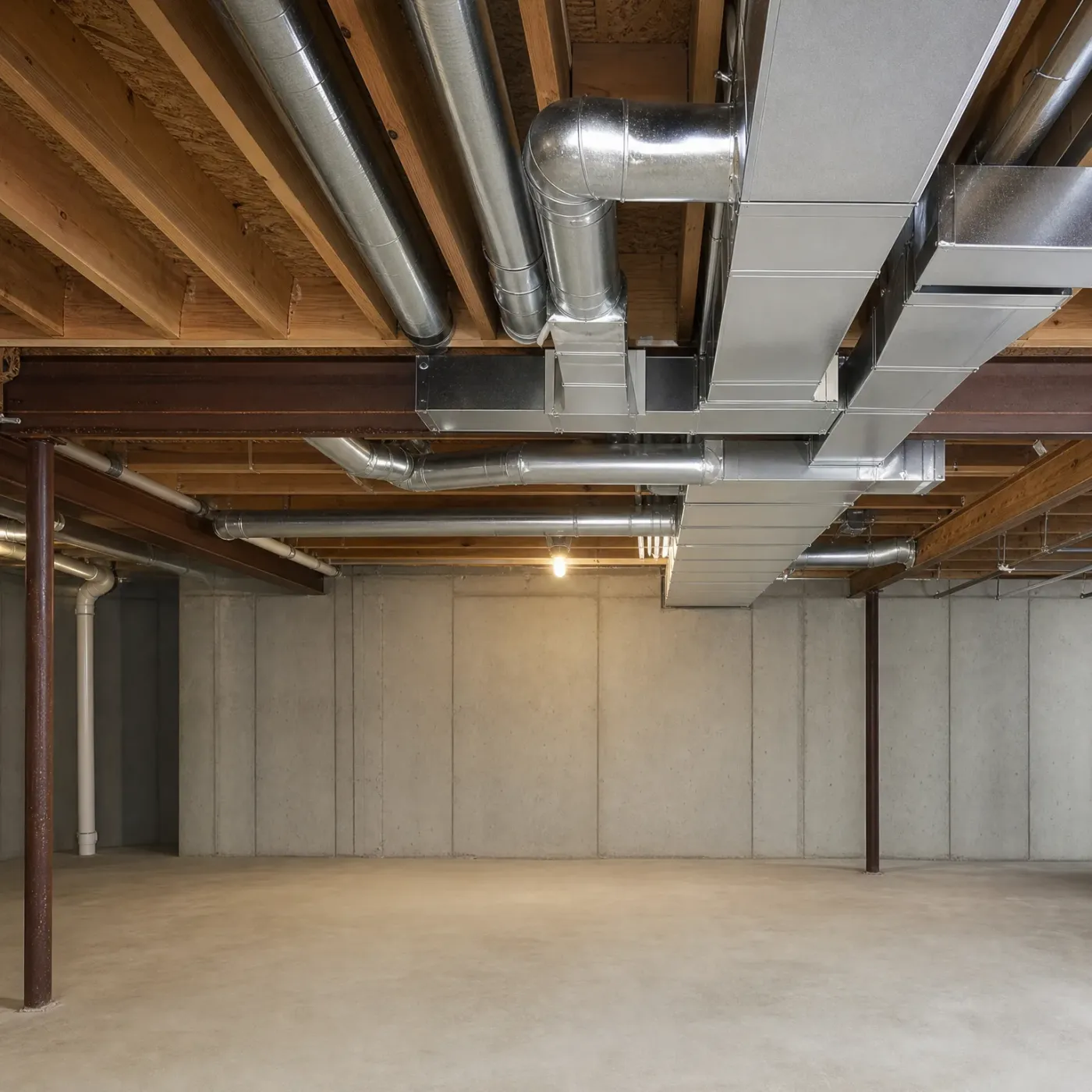
An empty unfinished basement with concrete floor and walls, exposed wood joists, steel beams and support posts, galvanized ductwork and pipes, and a single bare bulb light.

Clean, dry ductwork

Bare metal trunks and flex runs hang under the joists with no staining anywhere. The concrete floor stays dry and the air near the vents has no smell to it. Condensation isn't collecting on the metal, so mold has nothing to grow on.
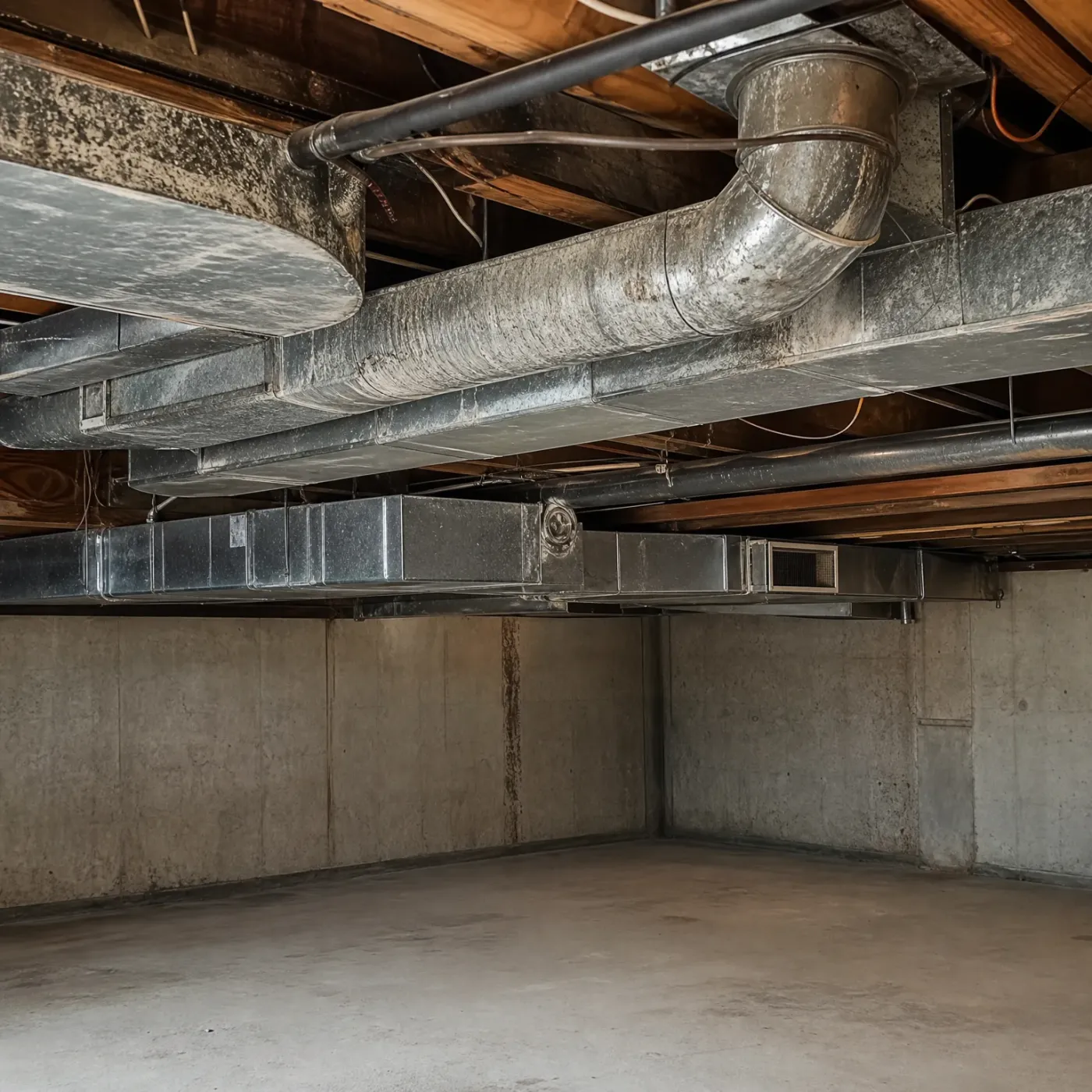

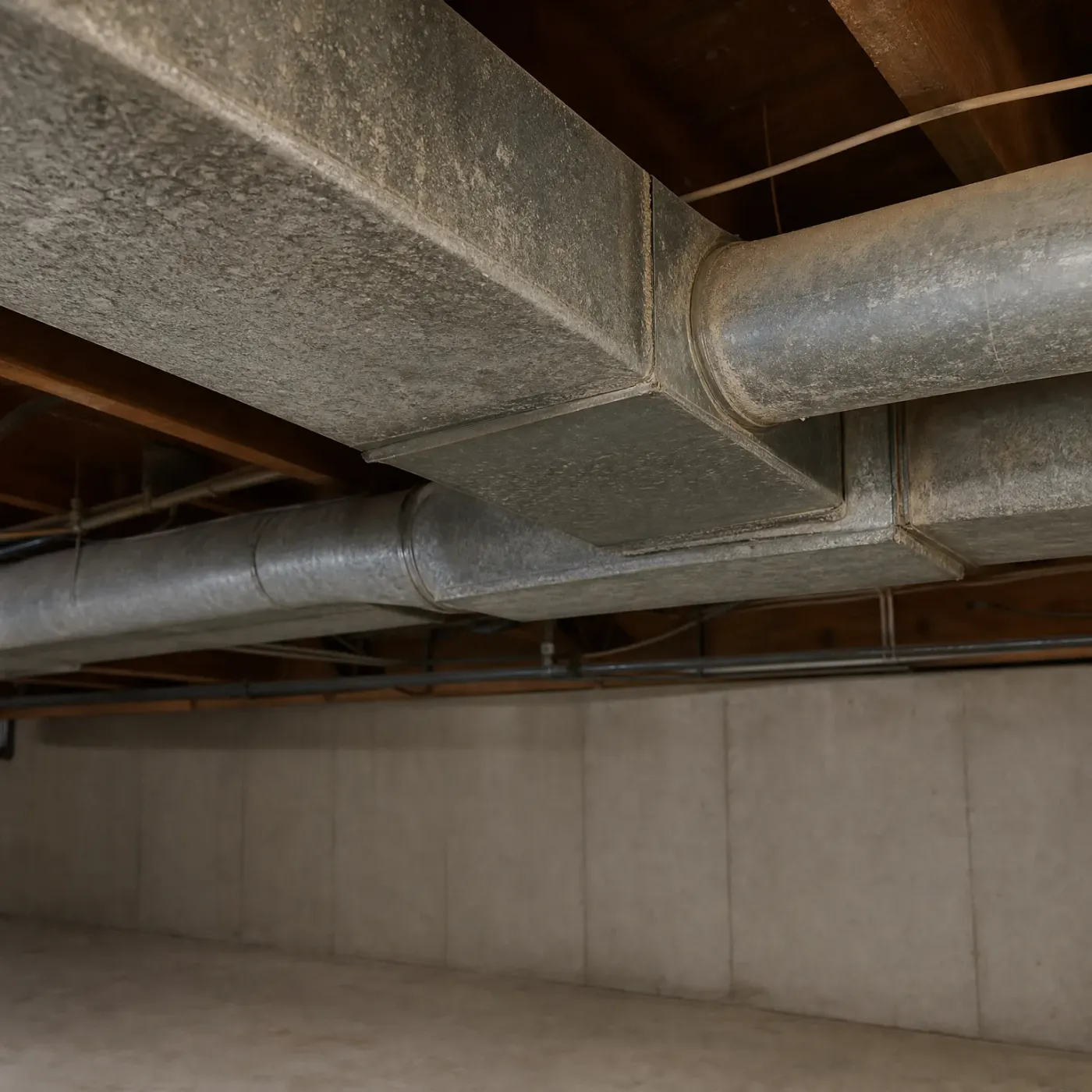
Empty basement with bare concrete walls and floor, with galvanized sheet-metal HVAC ducts, a round duct elbow, and pipes running along the wooden joists of the ceiling.

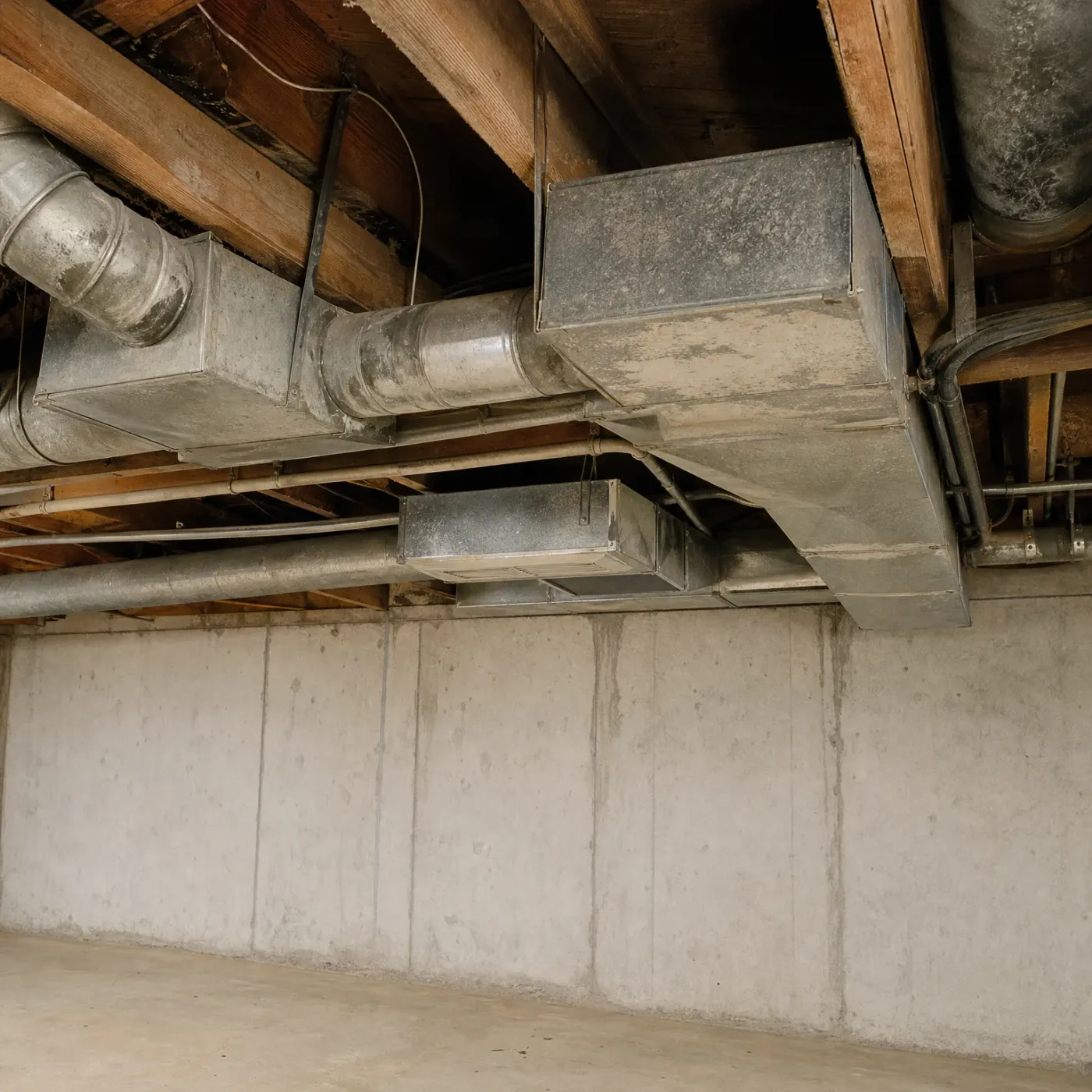
Mold on the duct surfaces

Dark staining runs along the joists and across the duct seams where moisture has been sitting. The steel trunk lines and the round branch duct both show it, not just one section. Once it's spread this far, cleaning the ducts won't hold unless whatever is keeping them damp gets fixed too.

Clean the Ducts or Fix the Cause

Clean the ducts

  • Removing the mold gets rid of what's circulating through the house right now, so the musty smell and visible spots are gone.
  • A contractor can check the duct runs for the sagging or damp sections where mold tends to settle again.
  • If the ducts are the only place moisture is collecting, cleaning them solves what you can see and smell today.
  • Cleaning doesn't change what let the moisture in, so mold can return in the same spots within a season or two.
  • On its own, cleaning won't help if the AC is oversized or short-cycling and leaving the air damp.

Fix the moisture source

  • If the AC is short-cycling or oversized, it's cooling the air without pulling humidity out, and that's what feeds mold growth.
  • Addressing the moisture means the ducts have less reason to grow mold back after they're cleaned.
  • This usually takes more than one visit, since it means looking at the equipment and the ductwork together.
  • Older duct joints and seams, common in homes built in 1958 or earlier here, may need sealing work beyond just cleaning.
  • Without clean ducts first, there's still mold sitting on dust and debris even after the moisture problem is handled.
  • A contractor who looks at both the system and the ducts can tell you which one is actually driving the problem.
  1. Moisture collects on cool duct surfaces or settles in damp sections

  2. Dust and skin cells on the duct walls give mold a food source

  3. Mold colonizes the duct seams and joints where damp air sits

  4. Spores release into the airflow every time the system runs

A woman wrapped in a thick fleece blanket sits on a sofa holding an open book, beside a lit table lamp and a frost-covered dark window.
A smiling older woman with gray shoulder-length hair in a cream cable-knit turtleneck sweater stands behind a wooden board holding a round loaf of bread, in a warmly lit kitchen with a dark window and shelves behind her.
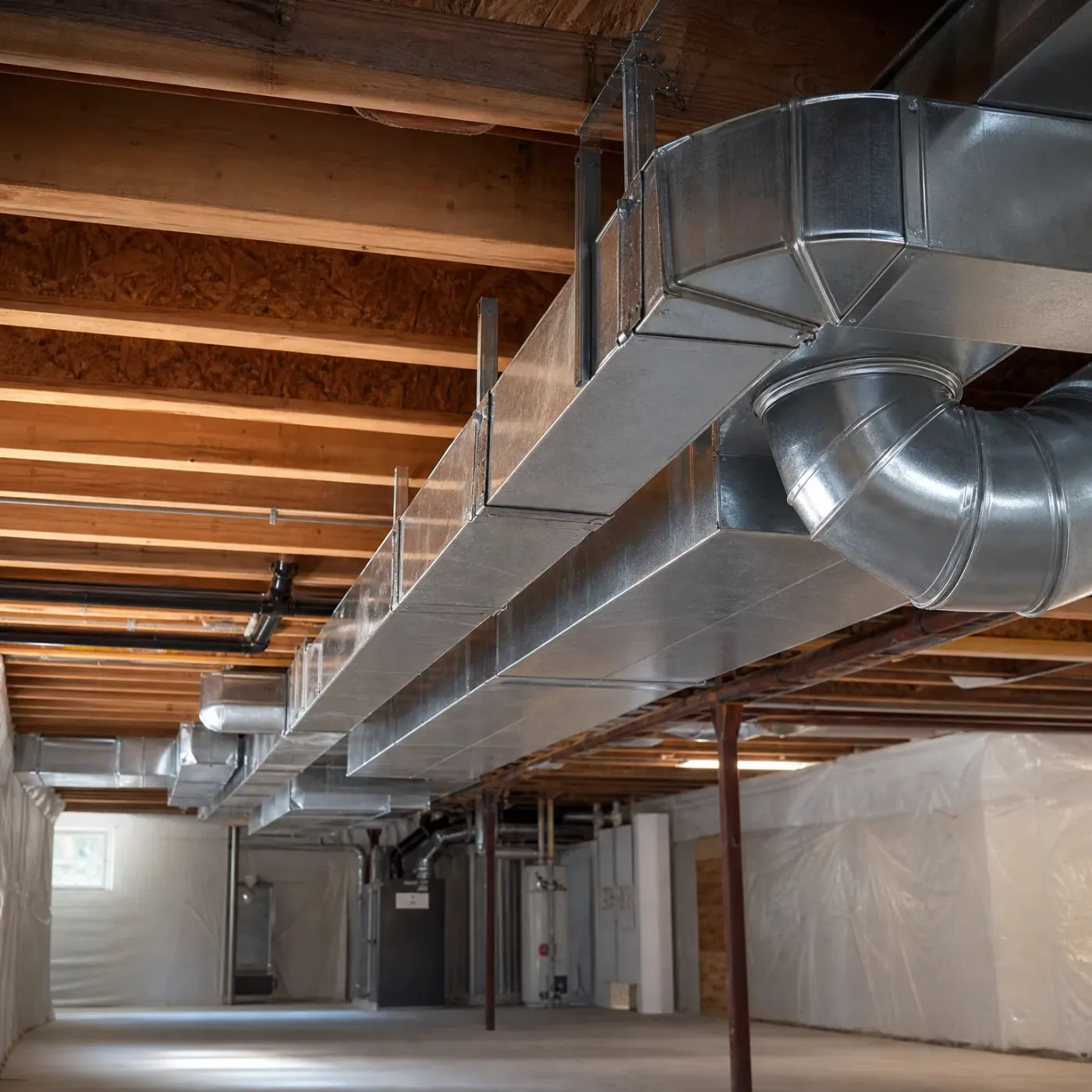
Unfinished basement with galvanized sheet-metal trunk ductwork and round branch ducts suspended beneath wood floor joists, with support posts, plastic sheeting on the walls, and a furnace and water heater along the far wall.

Get matched with a duct system pro in Essex County

Skip searching for someone who cleans ducts in Essex County.

Get matched with an Essex County pro who cleans ducts.

Get my match

You only hire the pro if you want to.

Can mold in air ducts make you sick?

You keep smelling that musty odor near the vents, or someone in the house has been dealing with a cough or stuffed-up sinuses that won't quit, and you're wondering if the two are connected. It's a fair thing to ask before you spend money on a cleaning.

It depends on the person, but mold spores circulating through the house can trigger symptoms

Mold spores moving through your ducts don't affect everyone the same way. People with asthma, allergies, or a weakened immune system tend to notice it first, with symptoms like sneezing, a runny nose, watery eyes, or a cough that doesn't clear up. Someone else in the same house might not react at all. The spores themselves are the issue, not the mold sitting in the duct. Every time the system runs, air moves across the colonized seams and carries spores into every room on that duct run. If symptoms seem to ease when you're out of the house and come back once you're home, that pattern is worth mentioning to a doctor and worth checking the ducts over.

Galvanized rectangular and round sheet-metal ductwork running beneath a wood-joist ceiling in a basement with concrete walls and floor, with pipes and wiring alongside.
Before you get your ductwork cleaning
Empty basement with bare concrete floor, painted block walls, and an exposed wood-joist ceiling with sheet-metal and insulated flexible ductwork and a steel support column.
After you get your ductwork cleaning

Why cleaning alone isn't the fix

Cleaning out an air duct removes the mold that's already there, but it doesn't change whatever let moisture in to begin with. A contractor who cleans the ducts can also look at how the system is set up, whether it's short cycling or oversized for the space, because that's what let the air stay damp long enough for mold to take hold. Skip that part and the ducts can grow mold again within a season, even right after a cleaning.

What a damp duct actually feels like

Run your hand along the duct near a joint on a humid day. If it's cool and a little wet to the touch, condensation is forming on the metal, and that moisture combined with dust on the surface is what mold needs to grow. Dry metal, even in August, means the system is pulling enough humidity out of the air before it reaches the ducts. That's the difference between a system doing its job and one that's feeding a problem.

Power here costs 24.38 cents per kilowatt-hour

Running a dehumidifier or an extra fan to keep ducts dry isn't free here. At 24.38 cents per kilowatt-hour, Essex County pays well above the national rate, so whatever you run to control moisture around your ductwork shows up fast on the bill.

EIA-861 2025

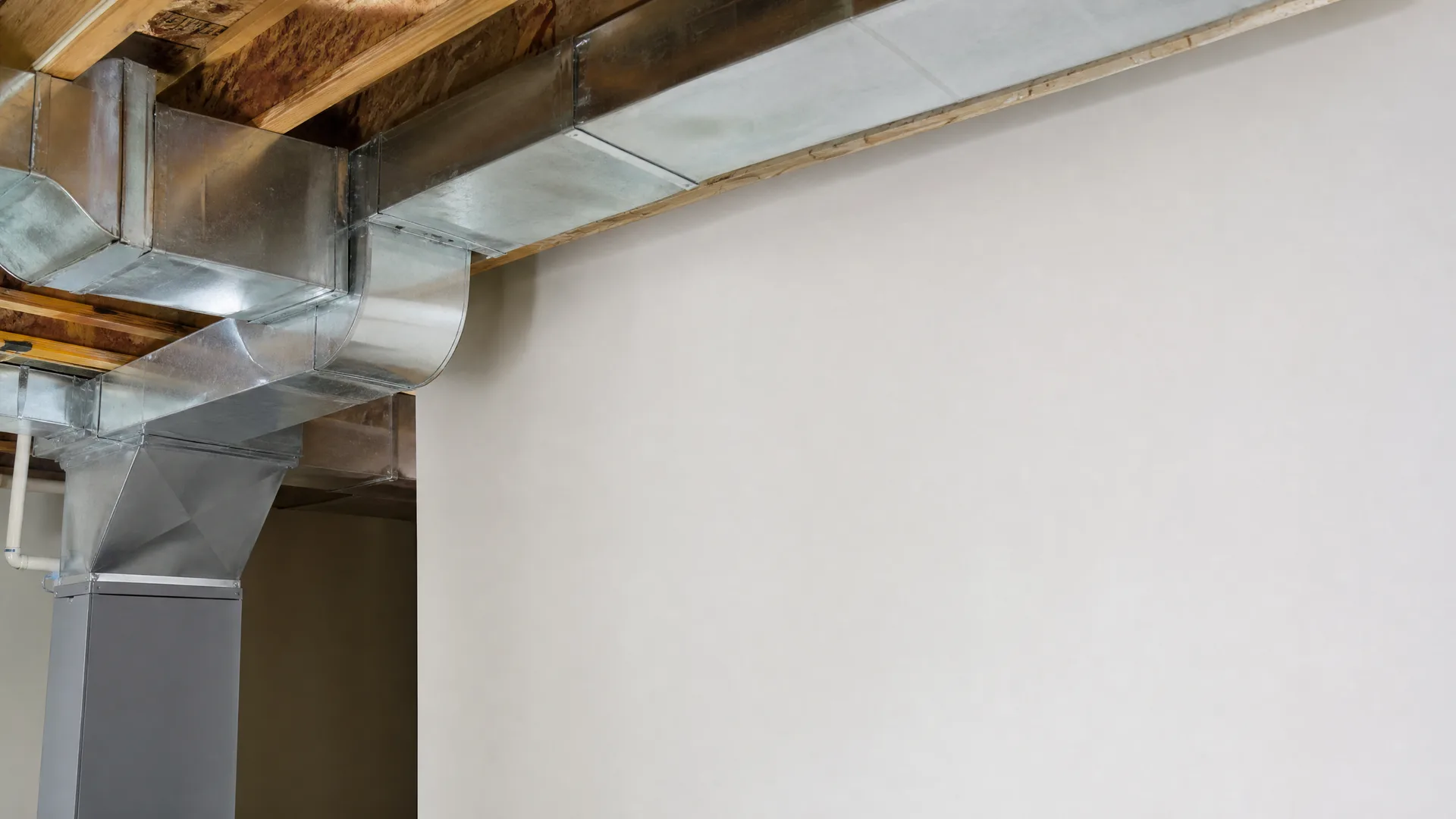
Galvanized sheet-metal HVAC ducts running along wooden joists at a basement ceiling, next to a plain off-white wall.

What mold does to your air

Every time the blower kicks on, air passes over the moldy section before it reaches your bedrooms and living room. The spores don't stay put. If you've noticed the smell is stronger in one room, that's probably the vent closest to the moldy run. Shutting that vent doesn't help much, since the duct system is sealed and connected, and air still finds its way through the trunk line to the rest of the house.

Unfinished basement interior with galvanized sheet-metal HVAC ductwork and round pipes running along a wooden joist ceiling, a furnace and water heater at the far end, and a blank white wall filling the left half of the frame.

What it does to your system

Mold doesn't stay confined to the metal. It spreads to the insulation wrapped around the ducts and to the filter, which has to work harder to catch what's circulating. A system fighting that extra load runs longer to move the same amount of air, and in a house heating from October through May and cooling through the muggy summer months, those extra run hours land on an electric bill that's already high for Essex County.

A woman stands in the open front doorway of a single-story house with a dark hipped roof and light siding, while a man in a navy jacket and cap is seen from behind in the foreground on the paved walkway.

Mold in your ducts has a cause, and it can be found

Mold in your ducts means moisture got in somewhere and something is feeding it. The smell near the vents, the staining on the seams, a cough that won't clear up, all of it traces back to damp air sitting where it shouldn't. Cleaning takes out what's circulating right now. Finding out why it got damp in the first place is what keeps it from coming back.

You don't have to sort out whether it's a short-cycling system, a sagging duct run, or something about how the house was built back in 1958 or whenever yours went up. A contractor who looks at the ducts can trace it. Instead of calling around Essex County explaining the same musty smell to three different companies and comparing quotes, you get matched with a contractor suited to this job, and they reach out to you.

A light gray sofa with gray and beige textured throw pillows and a cream knit blanket beside a white-framed window, with a small round side table holding a ceramic vase and potted greenery.
A single-story house with horizontal siding and large windows lit from within at dusk, beside a lawn, low path lights and a dark gravel driveway, with pine trees and a distant waterway under an orange and blue sky.

Ductwork Cleaning

Find a duct system cleaning pro in Essex County

Duct and vent cleaningDucts or ventsEssex County, NJ
Step 1 of 2

What ZIP code is the job in?

  • A beige upholstered armchair with a cushion and knit throw sits beside a double-hung window with a woven shade, next to a white fireplace mantel with a lit fire, a vase of greenery, and a round wooden table in the foreground.
    • Your request goes to an Essex County pro who takes ductwork jobs.
    • Describe your ductwork job, and a local pro who handles it gets in touch.
  • A shallow speckled beige ceramic bowl holding a leafy green branch sits on a wooden dresser beside a tall matte stoneware vase, with a window at left and a dark-framed picture at right.
    • Once you send the form, finding a pro is off your list.
    • After you send the request, you're done searching.
  • A ceramic table lamp with a pale tapered fabric shade sits on a rustic wooden table beside a wooden bowl, with a framed artwork on the beige wall and sunlight from a window at left.
    • Describe your ductwork job once, to one pro.
    • Fill out one short form instead of calling around.
  • A black box-shaped outdoor wall lantern with seeded glass panels and a lit filament bulb mounted on a light gray board-and-batten exterior wall, beside a dark-framed glass door, with green leafy shrubs in the foreground.
    • The pro who gets in touch is licensed in New Jersey and works in Essex County.
    • A licensed pro who works in Essex County gets your request.